


It doesn’t matter who you are, most Australians hope to get some money back from the Australian Taxation Office (ATO) when they lodge their annual tax return.
While bigger companies are likely to have a team of accountants working on their tax reporting, many individuals and small businesses manage it themselves. Before you begin putting your tax return together for the financial year, get to know the tax deductions you may be able to claim.
At a Glance: Tax Deductions You Could Be Claiming
- Working from home expenses
- Phone calls and internet usage
- Work bags
- Accounting costs
- Union or professional membership fees
- Car expenses
- Travel expenses
- Study costs
- Insurance premiums
- Office supplies, training and equipment
What is a Tax Deduction?
You can claim a tax deduction for some expenses you incur while working. The expense subtracts (deducts) from your assessable income to lower your taxable income and the amount of tax you pay. Tax deductions are often for work-related expenses, but may also be for other expenses like accountant fees or donations of $2 or more to deductible gift recipients.
As outlined by the ATO, if you’re an employee claiming a deduction for work-related expenses you need records of the expenses to show:
- the purchase itself (usually a receipt; a bank statement on its own is usually not sufficient evidence to claim a deduction)
- you spent the money yourself and were not reimbursed
- the expense directly relates to earning your income.
If an expense or item you purchase isn’t only related to earning your income, you’ll need a diary or similar record that shows your private and work-related use. You can only claim the work-related portion. Using this record, you can calculate the amount you can claim as a deduction.
Small businesses may also be able to claim home-based business expenses, accounting costs, motor vehicle expenses and travel expenses. You can claim a tax deduction for most expenses you incur in carrying on your business, as long as they are directly related to earning your assessable income.
To claim a work-related deduction as a small business:
- the expense must have been for your business, not for private use
- if the expense is for a mix of business and private use, you can only claim the portion that is used for business
- you must have records to prove it.
Did You Know? If you are an eligible business with an aggregated turnover under $10 million, you should be aware of the instant asset-write off. In the 2025-26 income year, eligible small businesses can deduct the business portion of the cost of eligible assets costing less than $20,000. To claim the immediate deduction in 2025-26, the asset must have been first used or installed ready for use during the income year. The $20,000 instant asset write-off limit applies on a per asset basis, so small businesses can claim an immediate deduction for multiple assets, as long as the cost of each asset is less than the limit.
Regardless of whether you’re an employee or a small business, you’re entitled to claim deductions for expenses that relate directly to earning your income, says Joanne McCauley, Principal of Jigsaw Tax & Advisory, a CPA firm that provides business tax and advisory services to small businesses. Be aware that what you can claim will depend on your circumstances, so she recommends seeking professional advice from your registered tax professional first.
“I have certainly seen some imaginative linkages between business income and expenses over the years,” she says. “If audited, you need to convince the ATO that the claim is legitimate, so if the claim is a little unusual, you need a good argument.” In other words, you need to make sure you are eligible to claim it.
Given that the definition of what can be deducted is so broad, sometimes it’s better to consider what you can’t claim, she adds. “Costs for [items] like [acquiring or renewing] your driver’s licence cannot be claimed, or relocation expenses if you move for [an existing or] new job.”
To help, we’ve answered common questions about the tax deductions you may be able to claim – but don’t forget to talk to a registered tax professional if you’re unsure. You can also check the:
- ATO occupation guides for job-specific work-related expenses you can claim at tax time, or
- ATO small business tax time toolkit if you’re a small business.
Can I Claim Working From Home Expenses?
If you meet certain requirements, that new sit-stand desk, ergonomic mouse and keyboard combo or second monitor that has changed your working from home life is potentially claimable.
But what actually makes you eligible to claim a working from home deduction? According to the ATO, you need to be carrying out your work as if you were in the office, not just checking your emails every now and then, as well as have a record of additional expenses incurred due to working from home.
There are two methods to choose from to calculate your working from home expenses. Take the time, or consult a registered tax professional, to work out which method you can use and then determine the one that gives you the best outcome.
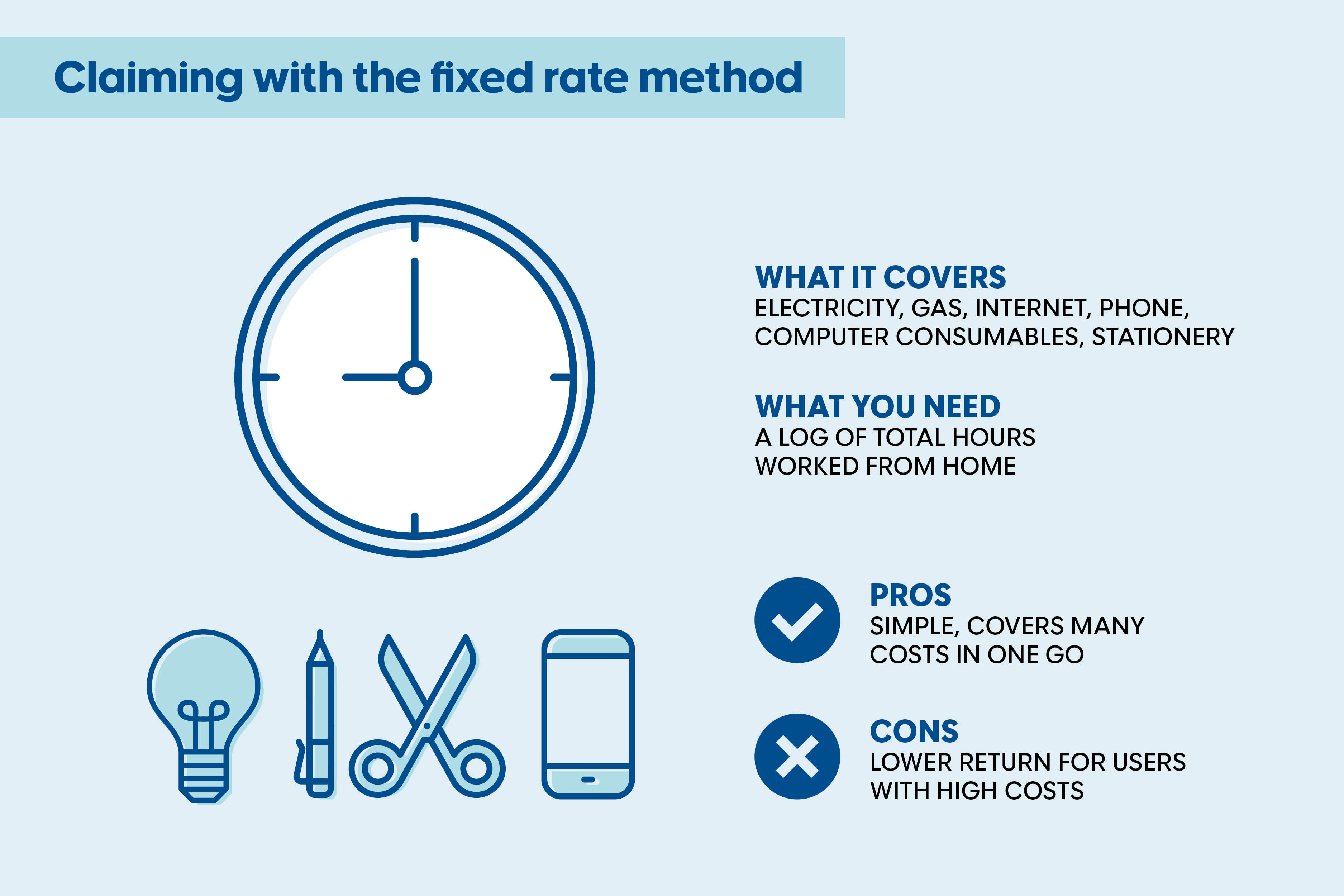
The Fixed Rate Method
The fixed rate method allows you to claim a set rate for every hour you work from home and covers your additional running expenses that are often difficult to apportion. This includes:
- phone and internet usage
- electricity and gas (energy expenses)
- stationery and computer consumables, such as paper and printer ink.
However, the set rate-per-hour does not include the decline in value of work-related equipment such as computers or office furniture, so the work-related use of these items can be calculated and claimed separately.
If an item (depreciating asset) costs $300 or less and you use it mainly to produce non-business income, you can claim an immediate deduction for its cost in the year you buy it. This could include items such as keyboards, power boards, desk lamps and chargers.
If an item you’ve purchased cost more than $300, you can claim a deduction for its decline in value over its effective life.
Note: To claim a deduction using the fixed rate method, you will need a record (kept at the time they occurred) of the total hours spent working from home for the entire income year. You also need one piece of evidence for each of the expenses covered by the rate that you incurred and records for items you claim as a separate deduction. For example, if you incurred phone and electricity expenses and bought a new laptop, keep one phone bill and one electricity bill, the purchase receipt for the laptop and records of how you calculated its decline in value and your work-related use.
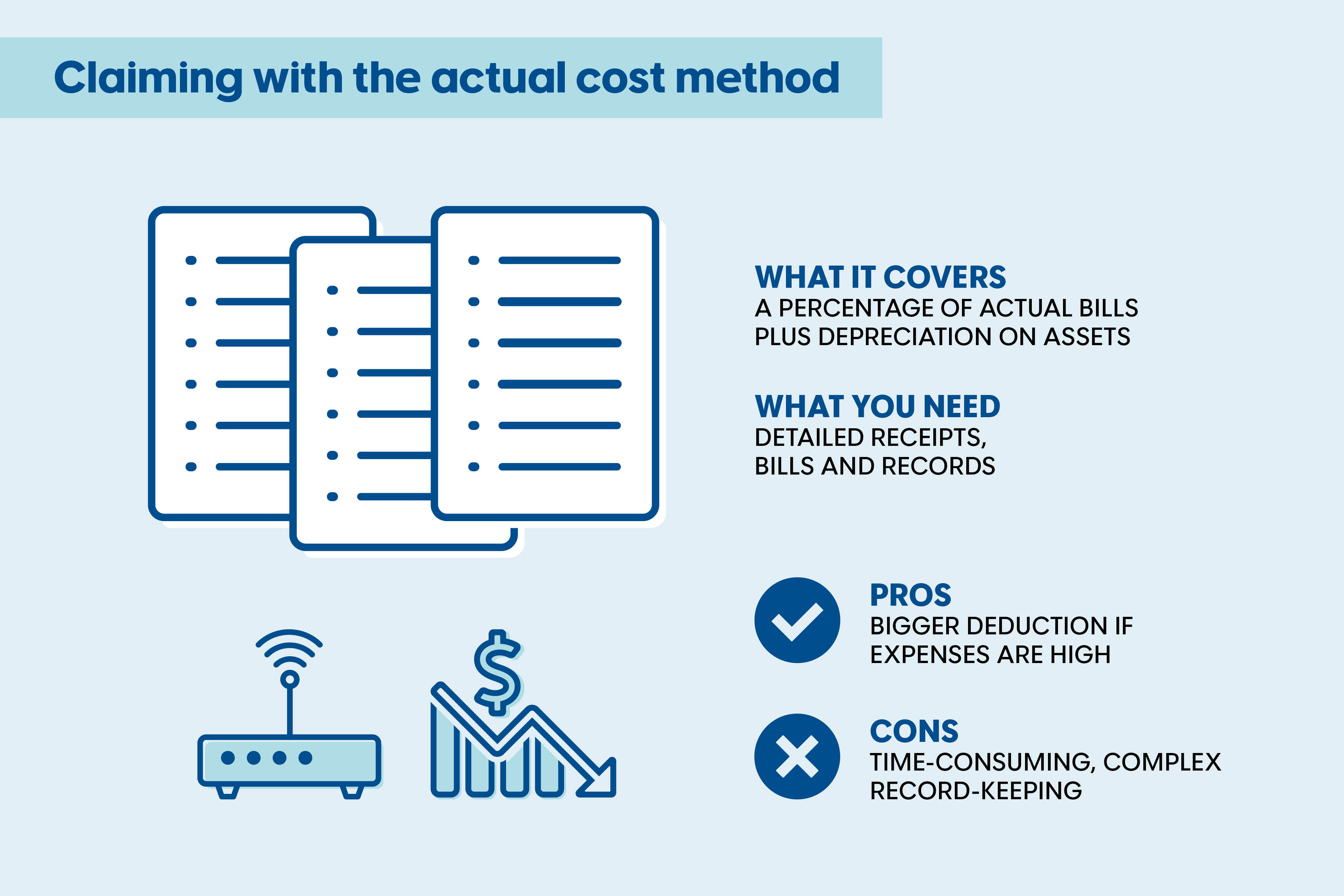
The Actual Cost Method
Using the actual cost method, you claim the cost of each expense incurred or the decline in value of depreciating assets used to work from home. To do this you must have detailed records that show the amount:
- you spent on expenses
- you spent on depreciating assets you buy and use while working from home
- of the work-related use of your depreciating assets and expenses incurred as a direct result of working from home.
You could claim an immediate deduction for equipment or tools that cost $300 or less if you use them wholly for work purposes. For items that cost more than $300, you will need to deduct their decline in value over their effective life.
When you work out your deduction for an asset’s decline in value, you take into account the life of the asset (its effective life) and the number of days during the year that you owned and used the asset for work purposes. For example, if you were to buy a laptop for $2,000 on 30 June this year and start using it 100 per cent for work purposes on that day, you get a deduction of about $3 (depending on the method you use) because you didn’t own the asset for many days during that financial year. However, in this situation your deduction for the next financial year may be higher as you owned the asset for longer during that year.
Your registered tax professional can help you with your working from home expenses calculation, or if you lodge yourself, use one of the ATO calculators available on their website.

Can I Claim Mobile Phone Calls and Internet Usage?
If you’re using your personal phone and internet for work purposes and you’re not using the fixed rate method to claim your working from home expenses, you can generally claim the work-related portion of the usage charges as a tax deduction.
To do so, make sure you keep your bills, and track your work-related calls vs private calls to work out the percentage of work-related use for your phone and internet expenses.
If your boss reimburses you for mobile calls or your internet, you can’t claim it. And if you are working from home and use the fixed rate method, you cannot claim these expenses separately as they are already included in the rate.
Hot Tip: Thinking of upgrading your phone? Find a mobile for work that you could claim on tax at Officeworks.
Can I Claim a Work Bag?
If you use the bag wholly for work purposes, such as carrying a laptop, tablet, phone, calculator or anything else you need to do your job, you may be able to claim a tax deduction for the cost of the bag, says H&R Block’s director of tax communications, Mark Chapman.
Be careful though: you’d struggle to claim that new Gucci clutch, he warns. “The handbag needs to be fit for work purposes, like carrying a laptop, and actually be used for work purposes.”
Can I Claim Accounting Costs?
You can claim accounting costs. If you went to see a registered tax professional to lodge your tax return last year, you can claim the expenses. Make sure you keep the receipt.
Can I Claim Union or Professional Membership Fees?
If you’re part of a professional organisation, such as a union or industry body that relates to your profession and you pay fees, you can claim these fees as a tax deduction.
Can I Claim Car Expenses?
If you’re required to use your own car for work reasons, you may be able to claim the expenses as a tax deduction. But remember, you generally can't claim the cost of travel between your home and your regular place of work.
There are two options to calculate car expenses – you either use a logbook (kept for a continuous period of at least 12 weeks), or you can claim cents per kilometre up to a maximum of 5,000km. Make sure you check if you’re eligible to claim car expenses.
Can I Claim Travel Expenses?
If you travel away from your home overnight in the course of performing your employment duties, you can claim travel expenses, such as meals, accommodation, fares and incidental expenses.
You’ll need to keep records to show that you were away overnight, you spent the money, and the travel was directly related to earning your employment income. You can’t claim a deduction if the travel is paid for or reimbursed by your employer or another person.
Can I Claim Study Costs?
You may be able to claim your self-education and study expenses if it relates to your work. The study must have sufficient connection to your current work duties; that is, the study must maintain or improve the skills you need for those duties, and not be used to get a new job. If you are eligible, you may be able to claim your course fees, stationery and textbooks.
SEE ALSO: What Tax Deductions Can You Claim When Working From Home?
Can I Claim Insurance Premiums?
If you pay for insurance premiums against loss of income, those amounts are also potentially tax deductible. “Bear in mind that doesn’t include life insurance, critical-care insurance or trauma insurance,” says Mark. “It also excludes policies paid for out of your superannuation contributions.” Businesses could claim the costs of insuring their property and, if you run a business from home, you may be able to deduct a portion of your home insurance premium.
Can I Claim Office Supplies, Employee Training and Equipment?
You can claim a tax deduction for most expenses you incur in running your business, as long as they’re directly related to earning the business’ income. For example, if you’re in hospitality or retail and invest in new POS (point-of-sale) equipment, it could be deductible immediately or over time.
And while things like stationery and employee training may be common business deductions that you remember, other workplace supplies like milk for the work kitchen are also possible deductions. However, employees working from home can’t claim their food, coffee, tea, milk and other general household items.
How to Organise Receipts for Tax Time
Receipts for a whole year’s worth of expenditure can seem pretty overwhelming, regardless of whether they’re digital or paper. If you keep paper records, simple document box files and expanding files can make a huge difference to prepping your return.
Start a new box file or folder for each month, so when tax time comes around, everything is already filed in the one place. Remember, too, that you’re expected to keep files for five years from the date you lodge your tax return, whether you’re an employee or a business, so if you do have lots of paper records, archive boxes are just the ticket.
Another clever way to keep track of receipts is by digitising. You can photograph or scan receipts to file on your computer, and if space is an issue, utilise a separate hard drive or cloud software. Online accounting software is another option.
For tax time, organise your receipts and invoices using the free myDeductions tool in the ATO app, which is user-friendly for employees and sole traders. Additionally, you can keep your Officeworks receipts handy in the Officeworks app or request a digital copy emailed to you from the friendly staff at your local Officeworks.
Hot Tip: If you are a business owner you can sign up for Officeworks for Business to seamlessly track and store orders for easy collation at tax time. As well as access other great benefits. It’s free to sign up if you have an eligible ABN.
SEE ALSO: Tax Return Tips to Get the Most Out of Your Return
Why Claiming Eligible Deductions Matters

If you’re wondering whether it’s worth the effort of claiming, the answer is yes. Some of your claims might seem small but they add up pretty quickly.
For more information, check out the ATO website for what individuals and businesses can claim.
This is general information only and does not constitute taxation or legal advice. Other requirements under the tax law apply. Seek professional financial and/or legal advice to determine the right outcomes for your business or individual needs.
This article was originally published January 2021 and has been updated.
